Processor-FPGA Communication: Using FIFO Processor Part
- Date:
20 Sep 2019
What are we gonna do?
We will write a simple counter in the FPGA Part, the counter increases \(1\) every
clkcycleThis counter makes a write request every \(2^{24}\)
clkcycle to the FIFO, and writes the counter value to the FIFOTo FIFO read port is connected to 3 PIOs generated by Platform Designer(Qsys), these 3 PIOs can be directly accessed by the Processor via memory mapping, since this memory is shared by the FPGA and Processor
Meanwhile, the 8 LEDs on the DE10-NANO board are connected to
usedw(used words) which indicates the number of data stored in the FIFOWe will write a simple reader in the Processor Part
User execute the compiled C code in the terminal, then they type in number of data to read
They will see read data printed to the terminal, as well as the decrease in number indicated by the LED
Modify the Standard Example HPS_FPGA_LED/main.c
Recall the address map earlier
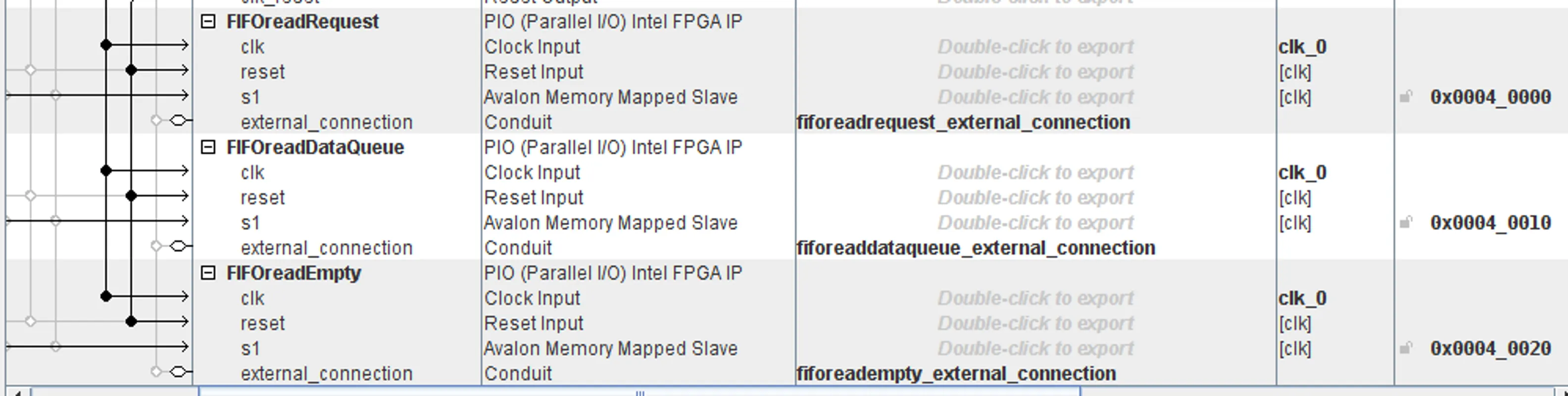
Use it
// FIFO
h2p_lw_FIFOreadRequest_addr = virtual_base + (
                (unsigned long)(ALT_LWFPGASLVS_OFST + 0x40000) &
                (unsigned long)(HW_REGS_MASK)
        );
h2p_lw_FIFOreadDataQueue_addr = virtual_base + (
                (unsigned long)(ALT_LWFPGASLVS_OFST + 0x40010) &
                (unsigned long)(HW_REGS_MASK)
        );
h2p_lw_FIFOreadEmpty_addr = virtual_base + (
                (unsigned long)(ALT_LWFPGASLVS_OFST + 0x40020) &
                (unsigned long)(HW_REGS_MASK)
        );
Handle FIFO reading
int FIFOread(){
        if(*(uint32_t *)h2p_lw_FIFOreadEmpty_addr != 1){
                *(uint32_t *)h2p_lw_FIFOreadRequest_addr = 1;
                usleep(1);
                *(uint32_t *)h2p_lw_FIFOreadRequest_addr = 0;
                return(0); // successful
        }
        return(1); // failed due to empty
}
The full code
#include <string.h>
#include <inttypes.h>

#include <stdio.h>
#include <unistd.h> // provides access to the POSIX operating system API
#include <fcntl.h>  // header in the C POSIX library
#include <sys/mman.h> // memory management
#include "hwlib.h" // location: SoC EDS\embedded\ip\altera\hps\altera_hps\hwlib\include
#include "socal/socal.h" // location: SoC EDS\embedded\ip\altera\hps\altera_hps\hwlib\include\soc_cv_av\socal
#include "socal/hps.h"
#include "socal/alt_gpio.h"

#include "hps_0.h" //

#define HW_REGS_BASE ( ALT_STM_OFST )
#define HW_REGS_SPAN ( 0x04000000 )
#define HW_REGS_MASK ( HW_REGS_SPAN - 1 )

//////////////////////////////////////////////////

void *virtual_base;
void *h2p_lw_led_addr;

// FIFO
void *h2p_lw_FIFOreadRequest_addr;
void *h2p_lw_FIFOreadDataQueue_addr;
void *h2p_lw_FIFOreadEmpty_addr;

int fd;

//////////////////////////////////////////////////

int memoryMapping(){
        // Map the **Address Space** for LED registers
        // into **User Space** so we can use them
        // We'll actually map in the entire CSR ??? span of
        // the HPS since we want to access various registers
        // within that span.

        fd = open("/dev/mem", ( O_RDWR | O_SYNC ) );
        if( fd == -1 ){
                printf("Error: can't open \"/dev/mem\" \n");
                return(1);
        }

        virtual_base = mmap(NULL, HW_REGS_SPAN, (PROT_READ|PROT_WRITE),
                MAP_SHARED, fd, HW_REGS_BASE);

        if(virtual_base == MAP_FAILED){
                printf("Error: mmap() failed \n");
                close(fd);
                return(1);
        }

        h2p_lw_led_addr = virtual_base + (
                        (unsigned long)(ALT_LWFPGASLVS_OFST + LED_PIO_BASE) &
                        (unsigned long)(HW_REGS_MASK)
                );

        // FIFO
        h2p_lw_FIFOreadRequest_addr = virtual_base + (
                        (unsigned long)(ALT_LWFPGASLVS_OFST + 0x40000) &
                        (unsigned long)(HW_REGS_MASK)
                );
        h2p_lw_FIFOreadDataQueue_addr = virtual_base + (
                        (unsigned long)(ALT_LWFPGASLVS_OFST + 0x40010) &
                        (unsigned long)(HW_REGS_MASK)
                );
        h2p_lw_FIFOreadEmpty_addr = virtual_base + (
                        (unsigned long)(ALT_LWFPGASLVS_OFST + 0x40020) &
                        (unsigned long)(HW_REGS_MASK)
                );

        return(0);
}

int FIFOread(){
        if(*(uint32_t *)h2p_lw_FIFOreadEmpty_addr != 1){
                *(uint32_t *)h2p_lw_FIFOreadRequest_addr = 1;
                usleep(1);
                *(uint32_t *)h2p_lw_FIFOreadRequest_addr = 0;
                return(0); // successful
        }
        return(1); // failed due to empty
}

int FIFOreadContinuously(){
        int i;
        int n;
        while(1){
                printf( "Number of words to read: ");
                scanf("%d", &i);
                for (n=0;n<i;n++){
                        if(FIFOread()==0){
                                printf( "Value: ");
                        printf("%" PRIu32 "\n",*(uint32_t *)h2p_lw_FIFOreadDataQueue_addr);
                                printf( "\n");
                        }
                        else{
                                printf( "Empty!\n");
                        }
                }
        }
        return(0);
}

int cleanMemoryAndExit(){
        if( munmap(virtual_base,HW_REGS_SPAN)!=0 ){
                printf("Error: munmap() failed \n");
                close(fd);
                return(1);
        }
        close(fd);
        return(0);
}

/////////////////////////////////////////////////////

int main(){
        memoryMapping();
        FIFOreadContinuously();
        cleanMemoryAndExit();
        return(0);
}