CODE 3D DPFT Momentum Space
- date:
28 Feb 2020
Highlight
3d implementation of DPFT
multi GPU acceleration using PyTorch
used 6d tensor instead of for-loop for acceleration
Todo
use suzuki-trotter for rho
save and recovery
\[\begin{split}\begin{align*}
& T_{\text{int}} = \int {d\pmb{k}}[{\pmb{\mu}^2\over 3}-{(\pmb{\mu}\cdot\pmb{k})^2\over \pmb{k}^2}] \eta[\rho(\pmb{p}+\hbar \pmb{k})-\rho(\pmb{p})] \\
\end{align*}\end{split}\]
Initialize
import torch as tc
import numpy as np
gpu = tc.device('cuda:0' if tc.cuda.is_available() else 'cpu')
Funcs
consts = [
  'x','y','z',
  'kx','ky','kz',
  'Tkin','TkinPrime',
  'TintIntegrand',
]

variables = [
  'rho','rhoPrime',
  'Tint',
]
getTkin
def getTkin(o,x,y,z):
  return x**2 + y**2 + z**2
getTintIntegrand
def getTintIntegrand(o,kx,ky,kz):
  c = o.config['Tint']
  mu = c['muVec']
  i = o.mu2over3 - (mu[0]*kx +mu[1]*ky +mu[2]*kz)**2 / (kx**2+ky**2+kz**2)
  return c['strength'] * i
make space
def makeSpace(p0,p1,Np):
  x = y = z = np.linspace(p0,p1,Np)
  x,y,z = np.meshgrid(x,y,z)
  x = tc.from_numpy(x)
  y = tc.from_numpy(y)
  z = tc.from_numpy(z)
  return x,y,z

def makeSpaceForTint(o):
  c = o.config['space']
  muVec = o.config['Tint']['muVec']
  p0,p1,Np,Nk = c['p0'],-c['p0'],c['Np'],c['Nk']
  shape = [Nk,Nk,Nk,Np,Np,Np]

  x,y,z = makeSpace(p0,p1,Np)
  x_ = tc.zeros(shape); x_[:][:][:] = x
  y_ = tc.zeros(shape); y_[:][:][:] = y
  z_ = tc.zeros(shape); z_[:][:][:] = z

  k = tc.linspace(p0,p1,Nk)
  kx = tc.zeros(shape)
  ky = tc.zeros(shape)
  kz = tc.zeros(shape)
  for i in range(Nk):
    for j in range(Nk):
      for l in range(Nk):
        kx[i][j][l] = k[i]
        ky[i][j][l] = k[j]
        kz[i][j][l] = k[l]

  o.mu2over3 = (muVec[0]**2+muVec[1]**2+muVec[2]**2)/3

  o.TkinPrime = getTkin(o,x_+kx, y_+ky, z_+kz).to(gpu)
  o.Tkin = getTkin(o,x,y,z).to(gpu)
  o.x,o.y,o.z,o.k = x.to(gpu),y.to(gpu),z.to(gpu),k.to(gpu)
  o.kx,o.ky,o.kz = kx.to(gpu),ky.to(gpu),kz.to(gpu)
  o.TintIntegrand = getTintIntegrand(o,kx,ky,kz).to(gpu)
  o.Tint = tc.zeros_like(x).to(gpu)
  o.rho  = tc.zeros_like(x).to(gpu)
getRho
def getRho(o,T):
  c = o.config['const']
  muMinusT = c['mu'] - T
  muMinusT[muMinusT<0] = 0
  rho = tc.pow(muMinusT,1.5)
  return rho
Tint
def getTintByArray(o):
  Tint = tc.zeros_like(o.kx).to(gpu); Tint[:][:][:] = o.Tint
  rho  = tc.zeros_like(o.kx).to(gpu);  rho[:][:][:] = o.rho
  rhoPrime = getRho(o, o.TkinPrime + Tint)
  stepFunc = rhoPrime > rho
  Tint = o.TintIntegrand * stepFunc
  return Tint.sum(0).sum(0).sum(0)
def getTintByLoop(o):
  Tint = tc.zeros_like(o.x).to(gpu)
  for kx in o.k:
    for ky in o.k:
      for kz in o.k:
        TkinPrime = getTkin(o,o.x+kx,o.y+ky,o.z+kz)
        rhoPrime = getRho(o,TkinPrime+o.Tint)
        stepFunc = rhoPrime > o.rho
        Tint[stepFunc] += getTintIntegrand(o,kx,ky,kz)
  return Tint
Main class
class DPFTM(tc.nn.Module):
  def __init__(self,config):
    super(DPFTM,self).__init__()
    self.config = config
    makeSpaceForTint(self)

  def forward(self):
    c = self.config
    for i in range(c['loop']['Imax']):
      oldRho = self.rho
      self.rho = getRho(self,self.Tkin + self.Tint)
      if(tc.sum(tc.abs(oldRho-self.rho))<c['loop']['sumDiffRho']): break
      if c['Tint']['method'] == 'array': self.Tint = getTintByArray(self)
      elif c['Tint']['method'] == 'loop': self.Tint = getTintByLoop(self)
    rho = self.rho.cpu().numpy()
    tc.cuda.empty_cache()
    return rho
Usage
run one test
import time
def test(config,label='undefined'):
  print('start: '+label); start = time.process_time()
  dpftm = DPFTM(config)
  if tc.cuda.device_count() > 1: dpftm = tc.nn.DataParallel(dpftm)
  dpftm.to(gpu)
  result = {'config':config,'label':label,'rho':dpftm(),
            'time':time.process_time() - start}
  print('finished in {t:.2f}'.format(t=result['time']))
  return result
save and plot
import pickle
import matplotlib.pyplot as plt

def save(results,savePath,filename):
  #filename += time.strftime("%Y%m%d-%H%M%S")
  with open(savePath+filename+'.pickle', 'wb') as handle:
    pickle.dump(results, handle, protocol=pickle.HIGHEST_PROTOCOL)

def plot(results,savePath,filename):
  mid = int(results[0]['config']['space']['Np']/2)
  fig, ax = plt.subplots(2, 2,dpi=200)
  for r in results: ax[0, 0].plot(r['rho'][mid][mid][:],label=r['label'])
  for r in results: ax[0, 1].plot(r['rho'][mid][:][mid],label=r['label'])
  for r in results: ax[1, 0].plot(r['rho'][:][mid][mid],label=r['label'])
  ax[1, 0].legend()
  fig.suptitle(filename); plt.savefig(savePath+filename+'.webp'); plt.show()
run many tests
config0 = {
    'space':{'p0':-5,'Np':30,'Nk':20},
    'loop':{'Imax':100,'sumDiffRho':1e-3},
    'const':{'mu':10},
    'Tint':{'muVec':[0,0,10],'strength':1,'method':'array'},
}
testCases = {
    'space':{
        'p0':np.linspace(-20,-5,4),
    },
    'const':{
        'mu':np.linspace(1,100,4),
    },
    'Tint':{
        'strength':np.linspace(0,1,4),
        'method':['array','loop'],
        'muVec':[ [0,0,z] for z in np.linspace(1,100,4) ],
    },
}

from google.colab import drive
import copy

def testMany(testCases,savePath):
  drive.mount('/content/drive')
  for key1 in testCases:
    for key2 in testCases[key1]:
      results = []; filename = key1+'.'+key2
      print('\n'+filename)
      config = copy.deepcopy(config0)
      for value in testCases[key1][key2]:
        config[key1][key2] = value
        results.append(test(config,str(value)))  #'{s:.2f}'.format(s=value)
      save(results,savePath,filename)
      plot(results,savePath,filename)

savePath='/content/drive/My Drive/Colab Notebooks/DPFTMoutput/'
testMany(testCases,savePath)
Mounted at /content/drive

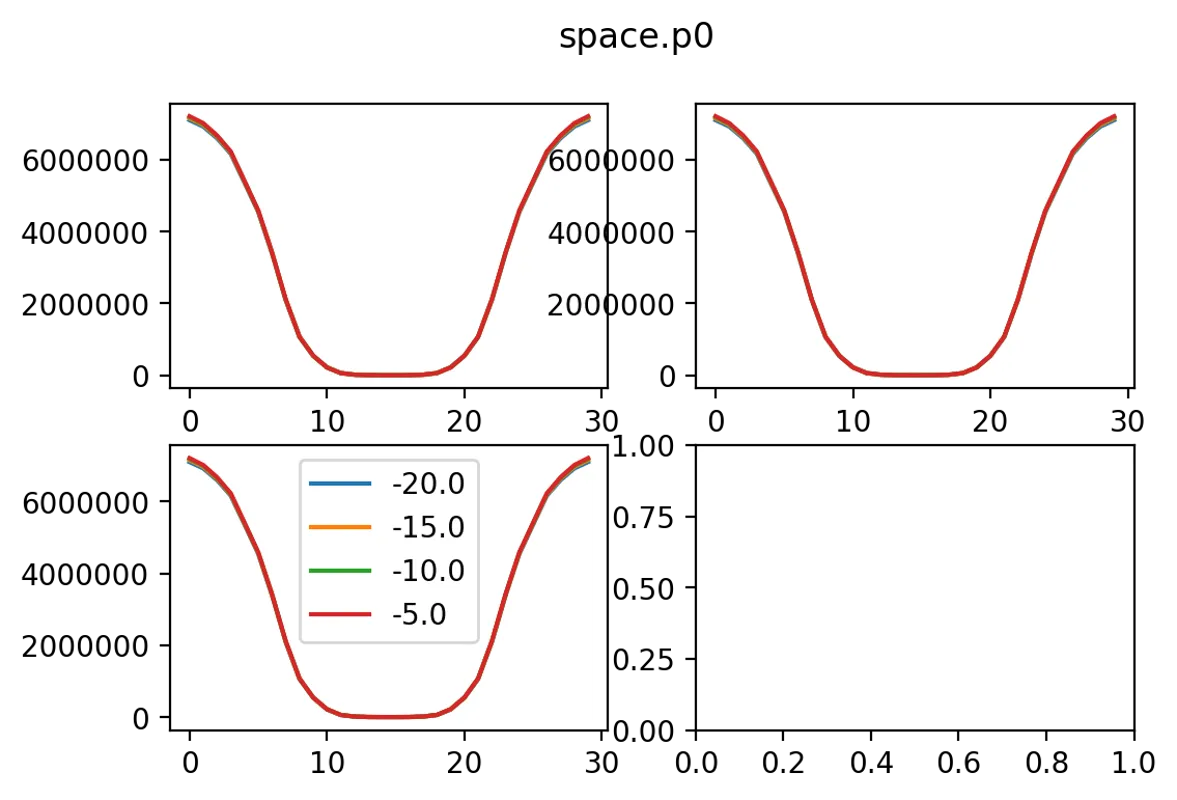
space.p0
start: -20.0
finished in 1081.05
start: -15.0
finished in 1051.63
start: -10.0
finished in 1045.05
start: -5.0
finished in 1020.56
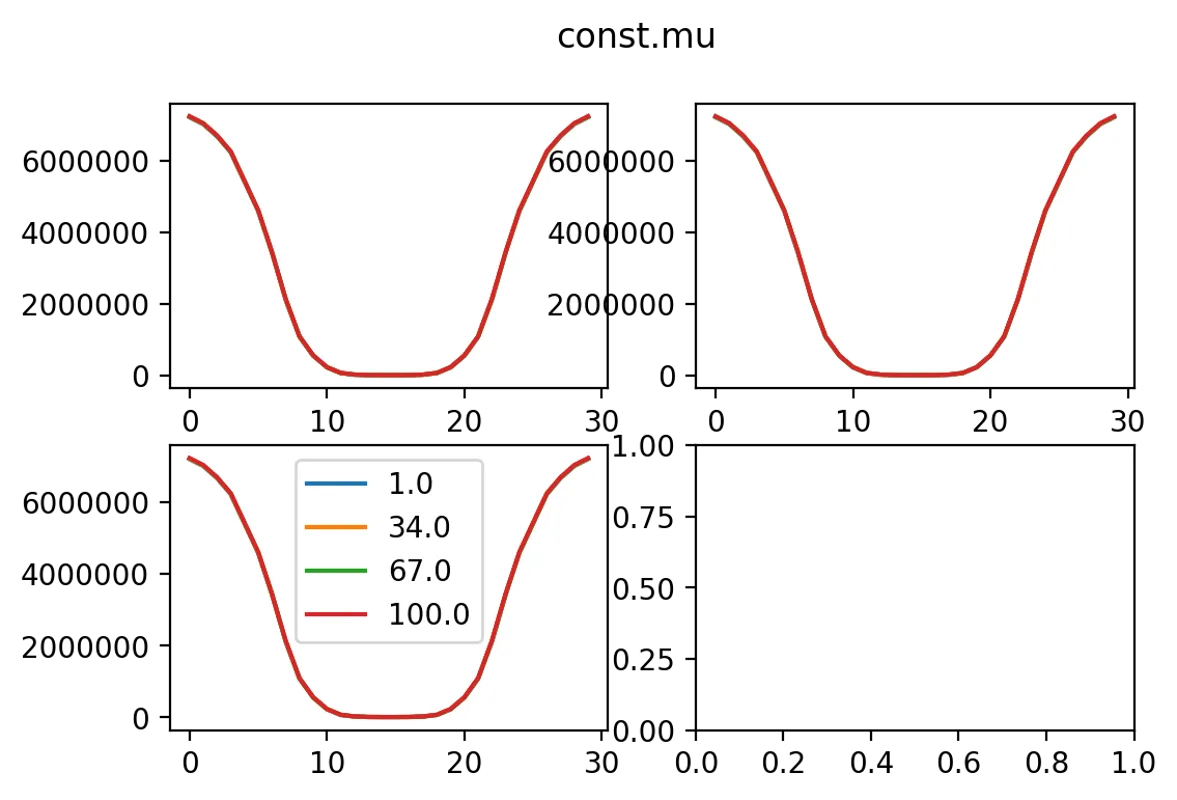
const.mu
start: 1.0
finished in 1045.80
start: 34.0
finished in 950.94
start: 67.0
finished in 866.85
start: 100.0
finished in 811.09
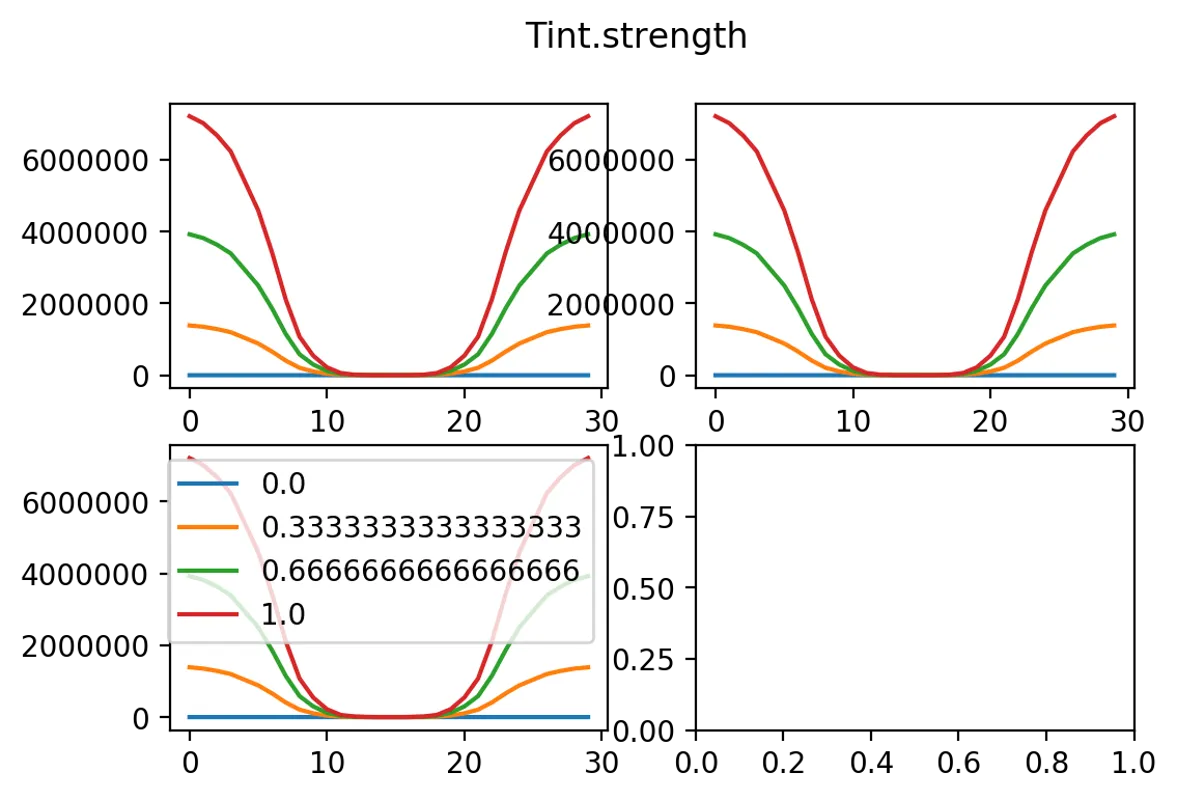
Tint.strength
start: 0.0
finished in 21.63
start: 0.3333333333333333
finished in 1014.87
start: 0.6666666666666666
finished in 1017.29
start: 1.0
finished in 1016.45
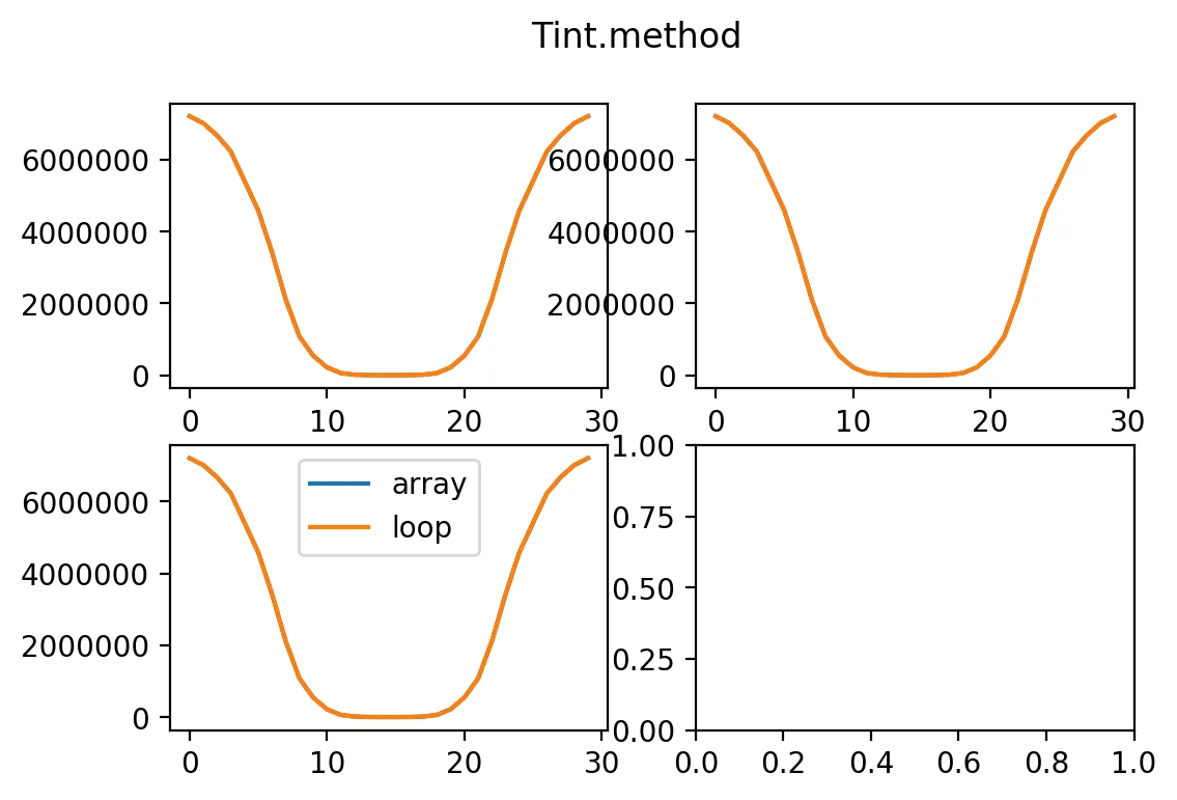
Tint.method
start: array
finished in 1013.86
start: loop
finished in 7154.09
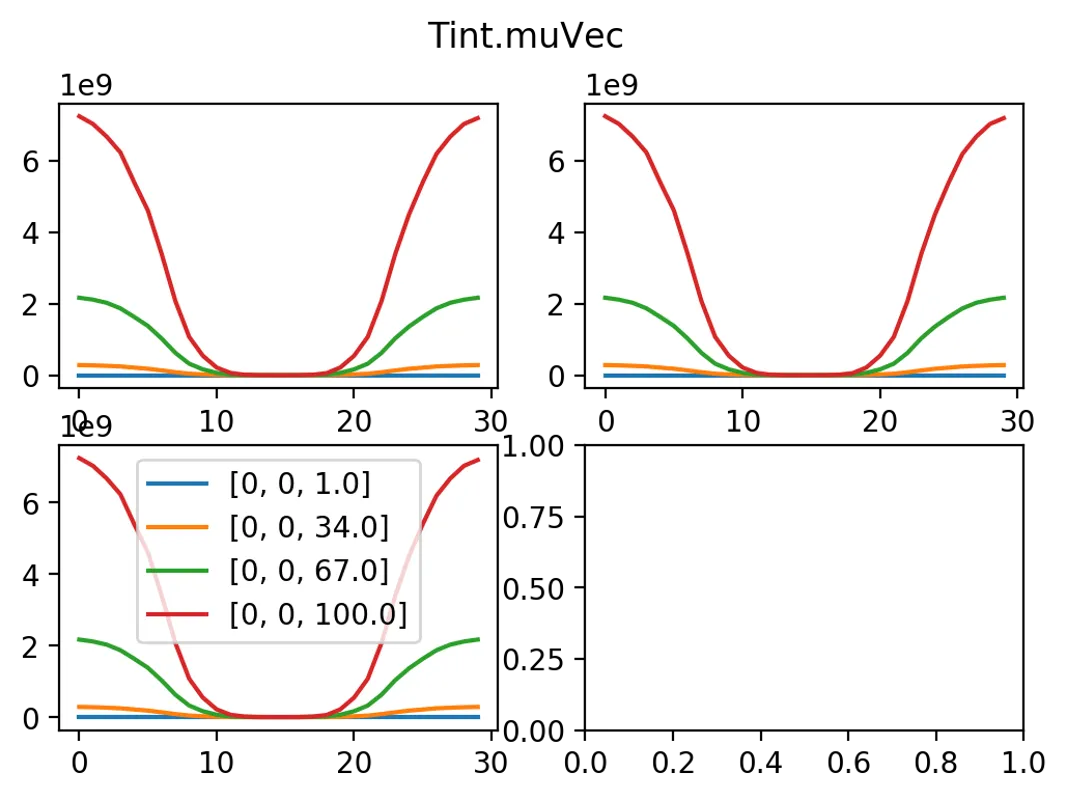
Tint.muVec
start: [0, 0, 1.0]
finished in 1117.56
start: [0, 0, 34.0]
finished in 1015.45
start: [0, 0, 67.0]
finished in 1014.28
start: [0, 0, 100.0]
finished in 1017.37