Nodejs Talking To C Executable 2
- Date:
21 Sep 2019
What are we gonna do?
In last part, we tested the feasibility with very simple codes
The next step is to write up a module, because this is my coding style! I like things to be structured and organized!
C Part
#include <string.h>
#include <inttypes.h>
#include <stdlib.h>

#include <stdio.h>
#include <unistd.h> // provides access to the POSIX operating system API
#include <fcntl.h>  // header in the C POSIX library
#include <sys/mman.h> // memory management
#include "hwlib.h" // location: SoC EDS\embedded\ip\altera\hps\altera_hps\hwlib\include
#include "socal/socal.h" // location: SoC EDS\embedded\ip\altera\hps\altera_hps\hwlib\include\soc_cv_av\socal
#include "socal/hps.h"
#include "socal/alt_gpio.h"

#define HW_REGS_BASE ( ALT_STM_OFST )
#define HW_REGS_SPAN ( 0x04000000 )
#define HW_REGS_MASK ( HW_REGS_SPAN - 1 )

//====================================

void *virtual_base;

// FIFO memory address
void *h2p_lw_FIFOreadRequest_addr;
void *h2p_lw_FIFOreadDataQueue_addr;
void *h2p_lw_FIFOreadEmpty_addr;

// PIO memory address
void *h2p_lw_PIO_addr;

int fd;

//====================================
//    Memory Handlers
//====================================

int memoryMapping(unsigned long PIObase){
    // Map the **Address Space** for LED PIOs
    // into **User Space** so we can use them
    // We'll actually map in the entire CSR ??? span of
    // the HPS since we want to access various PIOs
    // within that span.

    fd = open("/dev/mem", ( O_RDWR | O_SYNC ) );
    if( fd == -1 ){
        printf("Error: can't open \"/dev/mem\" \n");
        return(1);
    }

    virtual_base = mmap(NULL, HW_REGS_SPAN, (PROT_READ|PROT_WRITE),
        MAP_SHARED, fd, HW_REGS_BASE);

    if(virtual_base == MAP_FAILED){
        printf("Error: mmap() failed \n");
        close(fd);
        return(1);
    }

    // FIFO mapping
    h2p_lw_FIFOreadRequest_addr = virtual_base + (
        (unsigned long)(ALT_LWFPGASLVS_OFST + 0x40000) &
        (unsigned long)(HW_REGS_MASK)
    );
    h2p_lw_FIFOreadDataQueue_addr = virtual_base + (
        (unsigned long)(ALT_LWFPGASLVS_OFST + 0x40010) &
        (unsigned long)(HW_REGS_MASK)
    );
    h2p_lw_FIFOreadEmpty_addr = virtual_base + (
        (unsigned long)(ALT_LWFPGASLVS_OFST + 0x40020) &
        (unsigned long)(HW_REGS_MASK)
    );

    // PIO mapping
    if(PIObase>0x40020){
        h2p_lw_PIO_addr = virtual_base + (
            (unsigned long)(ALT_LWFPGASLVS_OFST + PIObase) &
            (unsigned long)(HW_REGS_MASK)
        );
    }

    return(0);
}

int cleanMemoryAndExit(){
    if( munmap(virtual_base,HW_REGS_SPAN)!=0 ){
        printf("Error: munmap() failed \n");
        close(fd);
        return(1);
    }
    close(fd);
    return(0);
}

//====================================
//    FIFO Handlers
//====================================

int FIFOread(){
    if(*(uint32_t *)h2p_lw_FIFOreadEmpty_addr != 1){
        *(uint32_t *)h2p_lw_FIFOreadRequest_addr = 1;
        usleep(1);
        *(uint32_t *)h2p_lw_FIFOreadRequest_addr = 0;
        return(0); // successful
    }
    return(1); // failed due to empty
}

int FIFOreadNwords(int N){
    int n;
    for (n=0;n<N;n++){
        if(FIFOread()==0){
            printf("%" PRIu32 "\n",*(uint32_t *)h2p_lw_FIFOreadDataQueue_addr);
        }
        else{
            printf( "Empty!\n");
        }
    }
    return(0);
}

//====================================
//    PIO Handlers
//====================================

int setPIO(uint32_t setPIOvalue){
    *(uint32_t *)h2p_lw_PIO_addr = setPIOvalue;
    return(0);
}

//====================================
//    main
//====================================

int main(int argumentCount, char ** arg) {
    int NwordsToRead = (int) strtoul (arg[1], NULL, 0);
    unsigned long PIObase = strtoul (arg[2], NULL, 0);
    uint32_t setPIOvalue = (uint32_t) strtoul (arg[3], NULL, 0);

    memoryMapping(PIObase);
    FIFOreadNwords(NwordsToRead);
    if(PIObase>0x40020) setPIO(setPIOvalue);
    cleanMemoryAndExit();
    return(0);
}
Install Nodejs dependencies
First I create a directory called
SimpleDE10NANOIn
SimpleDE10NANO, execute
npm init  # go through the guide and make sure: entry point: (index.js)
npm install express --save
npm install socket.io --save
Make the module
make a file
SimpleDE10NANO/my_modules/SimpleDE10NANO.js, and put the following in it:
const {execFile} = require('child_process');

module.exports = class SimpleDE10NANO{
    constructor(hostIP, port, Cexecutable, FIFOdepth){
        var self = this;
        self.Cexecutable = Cexecutable;
        self.FIFOdepth = FIFOdepth;
        self.app = require('express')();
        self.httpServer = require('http').createServer(self.app);
        self.io = require('socket.io')(self.httpServer);

        self.app.get('/',(request,response)=>{
            response.sendFile(__dirname+'/index.html');
        });
        self.io.on('connection',(socket)=>{
            console.log('a user connected');
            socket.on('message',(message)=>{
                console.log('message:',message);
                if(message=="send me data"){
                    self.sendDataToClient();
                }
            });
        });
        self.httpServer.listen(port, hostIP, ()=>{
            console.log(`Server running at http://${hostIP}:${port}/`);
        });
    }

    sendDataToClient(){
        var self = this;
    }

    readFIFO(NwordsToRead){
        var self = this;
        //int NwordsToRead = (int) strtoul (arg[1], NULL, 0);
        //unsigned long PIObase = strtoul (arg[2], NULL, 0);
        //uint32_t setPIOvalue = (uint32_t) strtoul (arg[3], NULL, 0);
        var args = [NwordsToRead,0,0];
        const child = execFile(self.Cexecutable,args,(error,stdout)=>{
            if(error) throw error;
            console.log(stdout);
        });
    }

    testReadFIFO(NwordsToRead){
        var self = this;
        setInterval(()=>{
            self.readFIFO(NwordsToRead);
        }, 1000);
    }

    setPIO(){
        var self = this;
    }
}
The main program: index.js
make a file
SimpleDE10NANO/index.js, and put the following in it:
const SimpleDE10NANO = require("./my_modules/SimpleDE10NANO.js");
const simpleDE10NANO = new SimpleDE10NANO(
    hostIP = '127.0.0.1',
    port = 3000,
    Cexecutable = "./HPS_FPGA_LED",
    FIFOdepth = 256
);

simpleDE10NANO.testReadFIFO(1);
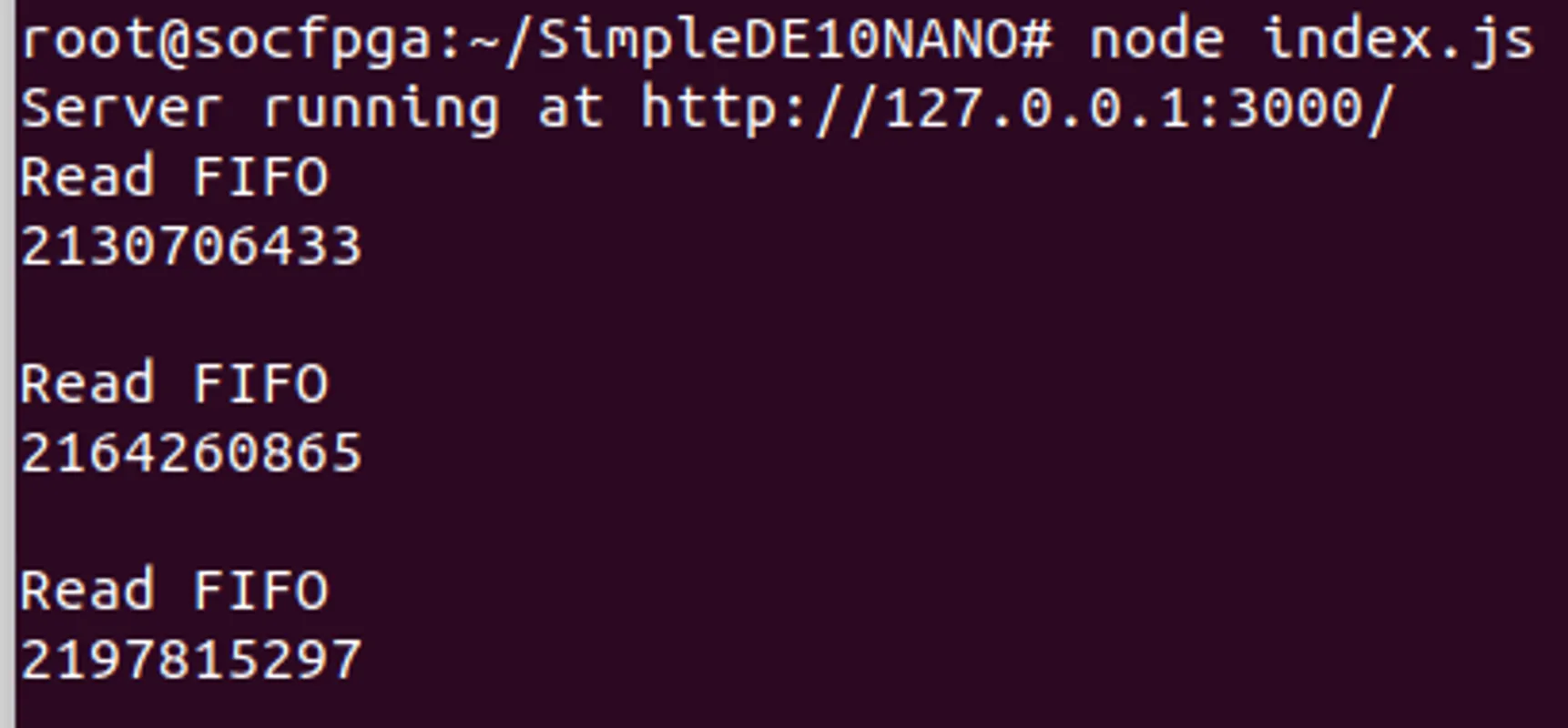
then command:
node index.jsresult: